 Miguel Ángel
1c20a107a6
* feat(player): a composition can no longer read the page that embeds the player

BREAKING CHANGE: the player's composition frame no longer shares the embedding page's origin
by default. Add sandbox-origin="same-origin" to keep reading the composition's DOM or runtime
directly (editors, recorders, custom timelines), only for compositions you trust.

* chore(skills): refresh the slideshow skill's manifest hash

* fix(player): a sealed player's timeout says how to play a composition without the runtime

A sealed player cannot add the runtime to a composition, so one with a GSAP timeline and no runtime never became
ready and failed with a bare timeout. The timeout now names the two fixes, the README says a sealed composition
brings its own runtime, and a browser test covers the sealed, trusted and runtime-bundled paths.

* test(player): the heavy-films bench embeds the trusted player, since it reads the film from inside

* test(player): the bench host stays sealed; only the bench that reads the film asks for trust

* test(player): the perf server answers CORS, so a sealed player's film loads its own media

* test(player): a sealed film on a host without CORS must still play its videos

* test(core): a sealed video whose CORS load fails loads again once without crossorigin

* fix(core): a sealed film's video loads once more without CORS when its host refuses CORS

* fix(core): the sealed media fallback reads its event target without a realm-bound instanceof

* fix(player): keep the player's origin sharing as today; sealing stays opt-in with sandbox-origin

* test(core): a failed sealed media source spares its siblings; a refused URL drops the helper's CORS

* fix(core): a sealed film tries every CORS source before falling back and drops CORS for refused URLs

* fix(cli): the play page shares its origin as today; docs say sealing is opt-in

* refactor(core): split the sealed media fallback into small steps

* test(player): sealed media decides CORS per element in Chrome; probe advice follows the policy

* fix(core): each sealed media element owns its CORS choice; probe advice follows the policy

* test(player): a sealed player's late timeline expects the sealed advice; media cases await each read

* test(player): sealed media rows for a skipped first source, author writes and a recovered URL

* fix(core): sealed media falls back only when the browser has no source left, once per URL

* test(player): the skipped-source row's loads are never cached, so each one is counted

* test(player): the skipped-source row bounds the video's load attempts as well as its requests

* test(player): sealed media rows for a mismatched-source reload, an outage and two refusing sources

* fix(core): a sealed media element owns one fallback state; only a played fallback is remembered

* test(player): a generated table of sealed media edits, each element checked on its own

* fix(core): sealed media CORS is decided per element and chosen source, with no shared cache

* test(player): the media table counts the runtime's loads against other selections

* fix(core): a sealed media element guesses the source it last played

* test(player): the media table attributes loads exactly and lets a failing host stay down

* test: sealed media rows check per-element CORS; the generated table replaces the hand-picked ones

* fix(core): a media element's own src counts as the source that failed

* fix(core): starting sealed media CORS twice adds no second set of listeners

* test(player): judge the sealed media table against frames without the runtime

* test(player): compare the sealed media table with the same film unsealed

* test(player): run the unsealed control film before the sealed one in one tab

* test(player): judge an authored crossorigin only on the composition's value

* test(player): an all-own list returning to an upgraded URL keeps its pixels

* test(player): source and playback against the sealed film with the helper off

* test(player): count every runtime load of a table video, net of the film without the helper

* test(player): the all-own return row plays the other clip alone before the URL comes back

* test(player): judge every round of the sealed media table, not only the end

* fix(core): sealed media keeps the browser's source choice and its playback across our reloads

* test(player): the table plays a video only after the runtime has bound it

* fix(core): a sealed video drops a stale crossorigin its source already refused

* test(player): the table exempts foreign hosts from pixels and allows a range request per load

* test(core): unit rows for the source choice, down hosts and playback across reloads

* refactor(core): sealed media restores time through the media clock, and its failure path is split

* test(player): the table compares play() outcomes, recovers a down host, and reads a seek at seeked

* test(player): the table judges a seek by where it settles and lets a composition pause on rejection

* test(player): the table holds the helper to a play() the film without it resolved

* test(player): pin the generated sequences that found the recovery and play() faults

* test(player): a slow host keeps the composition's play() pending when its source fails

* test(player): pin the sequences that find the play() and recovery faults with the slow host

* test(player): the table can start its generated sequences at any seed

* test(player): pin the generated sequences that find the recovered source skipped

* test(player): keep the pinned sequences that are red in every run in both browsers

* test(player): a looping video starting over is not a seek after the composition's

* fix(core): a sealed video retries a recovered source and keeps the composition's play() alive

* test(core): the playback row watches the play() the runtime's retry makes

* test(player): a slow host delays its first answer only; the composition's own abort is skipped

* test(player): a loop restart is told from a seek by where the seek began

* test(player): restarts are read at metadata, and a buffering control judges no playback

* test(player): the table counts and limits the comparisons it skips

* test(player): our restore after a composition seek stays within a frame; all selections count

* test(player): a playhead counts as moving if it moves within a second

* fix(core): only the composition's own load() makes a sealed video retry a down source

* fix(core): a sealed video's down source stays down through the runtime's preload load

* test(player): judge sealed media rows by what each step makes possible, not page timing

* test(player): print sealed and unsealed seek landings each sealed media run

* test(player): read a looping clip after its loop restart in every film alike

* fix(core): the runtime's preload loads a media element once per source list

* fix(core): the runtime's prefetch shares the preload's one load per source list

* test(player): a table step interrupts the CORS handling's own reload, not the runtime's preload

* test(core): an undo puts a clip's colour grade back in a sealed preview in place

* fix(core): an undo of a colour grade applies in place in a sealed preview

* test(player): a second table seek lands during the CORS reload of a playing clip

* test(core): an undo in a sealed preview keeps the media attributes the runtime added

* fix(core): an undo in a sealed preview keeps the media attributes the runtime added

* test(player): the playing-clip seek row plays a clip that starts past 0, as a trimmed one does

* test(player): the playing-clip seek is armed with its video, before the play step waits

* test(player): the down-then-back row reloads again, so every film's control has a frame

* test(player): the playing-clip seek row's host answers late, so the clip plays before its reload

* fix(player): a sealed player plays a same-site composition with the runtime it ships

* fix(player): a switch to video unloads a sealed composition shown as srcdoc

* test(core): the runtime's preload mid-selection keeps a down source's mark

* fix(core): a sealed film's down source keeps its mark through the runtime's own loads

* chore(player): fallow reads the cjs and iife runtime file as an entry

* fix(core): declare the html-tokens subpath where package exports are generated

* fix(player): a sealed composition that brings its runtime loads by src under its own headers

* test(player): expect the sealed player's own timeout message in the late-runtime tests

* test(core): a grade undo on a far clip whose length is loading applies in place

* fix(core): a far clip's length probe records the preload it sets, so a grade undo applies

* fix(player): a sealed film shown as srcdoc keeps its URL, so its sound still plays

* test(player): the late-timeline switch uses a film from another origin, which must still fail

* fix(player): a sealed Studio preview keeps its own runtime and loads by src

* fix(player): the player package carries the runtime once, and Studio none

* fix(core): a sealed video reads its own source's pixels in a list that names another host

* fix(player): a sealed player with no bundler still gets the runtime, only when it needs it

* fix(core): keep the mixed-list change within the comment budget

* fix(core): opt a mixed list in only when its first source plays, so a reload keeps that video

* fix(core): a CORS reload keeps the source that was playing

* fix(core): the composition's own load() picks from its full source list again

* fix(core): a reload's pin keeps a source type the composition wrote meanwhile

* fix(core): a reload's pin stops at the source the browser picked, not a skipped copy of its URL

* fix(core): a reload's pin stops at the source element that played, not the first copy of its URL

* fix(core): a reload's pin keeps the source element that played or refused

* style(core): format the source pin

* style(player): keep the runtime source comment under the line limit

* fix(player): only a real </script> closing tag ends a script in the runtime check

* test(player): count the sealed helper's loads by the crossorigin they change

* fix(core): a sealed video asks its host once before treating a failed CORS load as a refusal

* test(player): the sealed table expects pixels from a host that answers CORS after a failed load

* test(core): each refusal row waits for the CORS question it starts

* test(player): the sealed media table waits on each clip's own events

* refactor(core): a pinned-out source's error gets its own check in the sealed media helper

* test(player): the loop restart wait keeps its two-second window

* style(player): format the table's event wait

* chore(fallow): resolve workspace exports to source as bun does, so no false package cycle

* refactor(player): read script tag attributes in small steps, the same result

* refactor(player): the shader loading attribute reads its words from one table

* refactor(player): the attribute helpers' names say what their comments did

* fix(core): the CORS question never follows a redirect, and stays quiet while it waits

* style(core): format the CORS question's rows

* test(player): a sealed same-site page keeps its own policy; a stuck fetch reports the limit

* fix(player): a sealed same-site page keeps its own policy, and a stuck fetch ends at the limit

* fix(player): a sealed page whose headers can't all be read, as after a redirect, loads by src

* style(player): format the sealed player and name the probe's preparation state







The open-source AI video editor: create, edit, remake.
Write HTML. Render video. Built for agents.
Download the app · Quickstart · Showcase · Catalog · Docs · Discord · X · YouTube

HyperFrames is HeyGen's AI video editor for people and agents. Describe a video, bring your own footage, or remake a video you love, and get a real project you can change down to the frame: ask for a bigger title, a faster cut or new captions, and it changes just that.
Underneath, HyperFrames is a free, open-source framework (Apache 2.0) for turning HTML, CSS, JavaScript, media and seekable animations into deterministic MP4 videos. Use it locally with the CLI, from AI coding agents like Claude Code, Codex and Cursor with skills, or as the rendering core behind hosted authoring workflows. No React required.
Three ways to use it
| Best for | Start | |
|---|---|---|
| HyperFrames Studio app | Anyone, no code. Describe a video or drop in your footage, then edit by typing or pointing. Use the built-in agent on Pro, or your own Claude Code or Codex. | Download for Mac, Windows or Linux (free plan) |
| Your coding agent | Claude Code, Codex, Cursor, Gemini CLI and other agents. | npx skills add heygen-com/hyperframes |
| Claude, ChatGPT or Grok (beta) | Making a video in a chat, nothing to install. ChatGPT: Business, Enterprise and Edu workspaces. | Connect HyperFrames by HeyGen, listed in Claude's connector directory |
The HyperFrames Studio app has a free plan. Pro ($25 a month) adds top video, image, voice and music models (HeyGen Video 1, Seedance 2.5, Lyria 3 Pro and more) and 25,000 credits a month.
Made with HyperFrames
 Script-based editing |  Edit your own footage |  Captions on your video |  Remake any video |
 Launch video from your website |  Faceless explainer |  Flat cartoon explainer |  Real-UI motion graphics |
 3D one-take trailer |  3D type |  Remotion project, ported |  Generative motion |
Click any clip to watch it with sound.
What you can make
| Video | How |
|---|---|
| Branded UGC videos for TikTok and Instagram from your own phone clips: captions, music, text hooks, fast client revisions | The Studio app: drop in your footage, then edit by typing or pointing |
| Video podcast episodes: line up a multi-camera recording, cut to whoever is talking, clean up the sound, add captions | The Studio app's podcast edit |
| Product demos, tutorials, launch videos and feature announcements, from your website or a screen recording | Paste your URL into the Studio app, or ask your agent |
| Explainer and faceless YouTube episodes from your topic, script or voiceover | Ask for one; /style-sampling for five proven series styles |
| Remake a video you love, then make it yours | /reverse-any-video |
| Social videos with kinetic captions, overlays, and music | /hyperframes with the catalog |
| Data visualizations, chart races, and map animations | Catalog blocks for charts and maps |
| PR walkthroughs and changelog videos with animated code diffs, narration, and captions | Point your agent at the pull request |
| Docs-to-video and site-tour explainers | Give your agent the document or link |
| Motion graphics with code instead of After Effects, reusable in automated content pipelines | The CLI, cloud render or AWS Lambda |
| Decks with presenter mode | /slideshow |
| Motion from a Figma file | /figma |
| A Remotion project, ported | /remotion-to-hyperframes |
By job: AI video editor · animated captions · add text to video · AI motion graphics · HTML to MP4 · Lottie to MP4 · SVG to MP4
Community skills (hyperframes-community-skills, community-maintained, review before use): camera-3d-captions (captions in 3D around a speaker), vox-explainer (collage explainers), p5-paint-animation (handwriting and paint-on), prod-by-claude (live-coded music videos), session-story and day-in-my-life (your agent sessions as films), duo (side-by-side phone memes), x-posting-license (an ID-card video for any X profile).
Quick start for developers
Using Claude Code, Codex, Cursor, or another coding agent? Install the skills once, then ask your agent to make a video.
Give your coding agent the skills (recommended)
npx skills add heygen-com/hyperframes     # pick "Core Skills" in the picker
# or, with no picker (scripts, CI):
npx hyperframes skills update
Then try: Using /hyperframes, create a 10-second product intro with a fade-in title, a background video, and subtle background music.
Claude Code plugin
claude plugin marketplace add heygen-com/hyperframes
claude plugin install hyperframes@hyperframes
Codex, Cursor, Gemini CLI, Copilot
See the plugin guide.
By hand, with the CLI
npx hyperframes init my-video
cd my-video
npx hyperframes preview      # live preview in the browser
npx hyperframes render       # render to MP4
Requirements: Node.js 22+ and FFmpeg. Render in the cloud with hyperframes cloud render, or on your own AWS Lambda.
Skill install options, updates and the core set (full details)
Claude Code plugin updates
To enable auto-update for the hyperframes marketplace, run claude in a
terminal in your project. In Claude Code's terminal UI, run /plugin, then select
Marketplaces → hyperframes → Enable auto-update. Afterward, use
/hyperframes:hyperframes. See the plugin guide
for Copilot, VS Code, Cursor, Gemini CLI, updates, and migration.
Standalone skills (including OpenCode)
The picker opens with nothing pre-selected — the Core Skills group is all you need;
/slideshow,/remotion-to-hyperframesand/figmainstall on demand. Without the picker (a script or a CI job),npx hyperframes skills updateinstalls exactly the core set, whereasskills add --allinstalls all 9 published skills. The six repo-internal skills under.claude/skills/.agents/skillsare excluded by default. For the full published set usenpx hyperframes skills.
skills addresolves the skills.sh registry blob, which can lagmainby hours.npx hyperframes skills updateinstalls the skills from the release tag that matches your CLI version, so they match the CLI that runs them.
Run project-local installs from your video project's directory. From a HyperFrames
checkout, use npx hyperframes skills update for a global install instead: a
project-local installer target can overlap the tracked skills/ source and
overwrite uncommitted edits. See contributor setup.
The skills teach agents the HyperFrames production loop: plan the video, write valid HTML, wire seekable animations, add media, lint, preview, and render. They work with Claude Code, Codex, Cursor, Gemini CLI, IBM Bob, and other coding agents that support skills.
Share a video for review
Sign in with npx hyperframes auth login, then run npx hyperframes share to
choose who can open the rendered review. Use share --update when edits should
become a new version and share --manage for web settings. CLI and Desktop use
the same sharing system and five free projects per workspace. Existing legacy
published links remain reachable.
Skills
HyperFrames ships 9 skills. Make any video by asking for it; the /hyperframes skill carries the contract and the references (film, captions, overlays, motion, look). Read it first.
The core set below is what npx hyperframes skills update installs and what the picker lists as "Core Skills". Install one skill with npx skills add heygen-com/hyperframes --skill <name>, or all 9 with --all. A non-interactive or agent run of npx skills add without --skill installs all 9. npx hyperframes init adds the core set only when it is missing and never touches a skill you already have; on-demand skills install with npx hyperframes skills update <name>.
Core set
| Skill | Use when |
|---|---|
/hyperframes |
Read first for any request to make, edit, animate or render a video, motion graphic, captions or overlays with HyperFrames (HTML rendered to video). Holds the render contract and the work loop, and points to the references for format, motion, look, captions, whole films and storyboards. |
/hyperframes-cli |
The HyperFrames CLI by job — scaffold, check, look at frames, edit the timeline, preview, render locally or in the cloud, share, project history — plus reading its JSON and recovering from build or render failures. |
/hyperframes-registry |
About 450 ready-made blocks and components installed as editable source — transitions, overlays, titles, kinetic type, captions, charts, maps, 3D, camera moves. Use before hand-building any named visual; also for hyperframes add and catalog. |
/media-use |
Get or make any media for a video — music, sound effects, images, icons, logos, voiceover, avatar and generated video, transcripts, cutouts, colour grades and looks — with HeyGen or free local tools, and mix placed audio. Also for footage that looks dark, flat or dull. |
/reverse-any-video |
Rebuilding any video file as an editable HyperFrames project (motion graphics, talking heads, live action, AI-generated footage), checked frame by frame against the original. |
/style-sampling |
Making a new episode on your topic in one of five proven styles: Collage Explainer, Finance Explainer, Animated Science Explainer, 3D Brand Explainer, 3D True Crime. |
On demand
| Skill | Use when |
|---|---|
/figma |
Bring Figma into a video — rendered assets, brand tokens, components, storyboard frames as reconstructed motion, shaders and connector-assisted motion. Use when you paste a figma.com link. |
/slideshow |
A presentation, pitch deck or interactive deck — discrete slides, fragment reveals, branching, hotspot navigation, presenter mode with speaker notes. Output is a navigable deck, not a rendered MP4. |
/remotion-to-hyperframes |
Bringing existing video code or footage into HyperFrames (Remotion first; also Motion Canvas, Lottie, Three.js, canvas, other tools' renders), verified frame by frame. |
For visual design handoff workflows, see the Claude Design guide and Open Design guide.
More from the community: hyperframes-community-skills.
Frame.md
frame.md — your design system, ready for video.
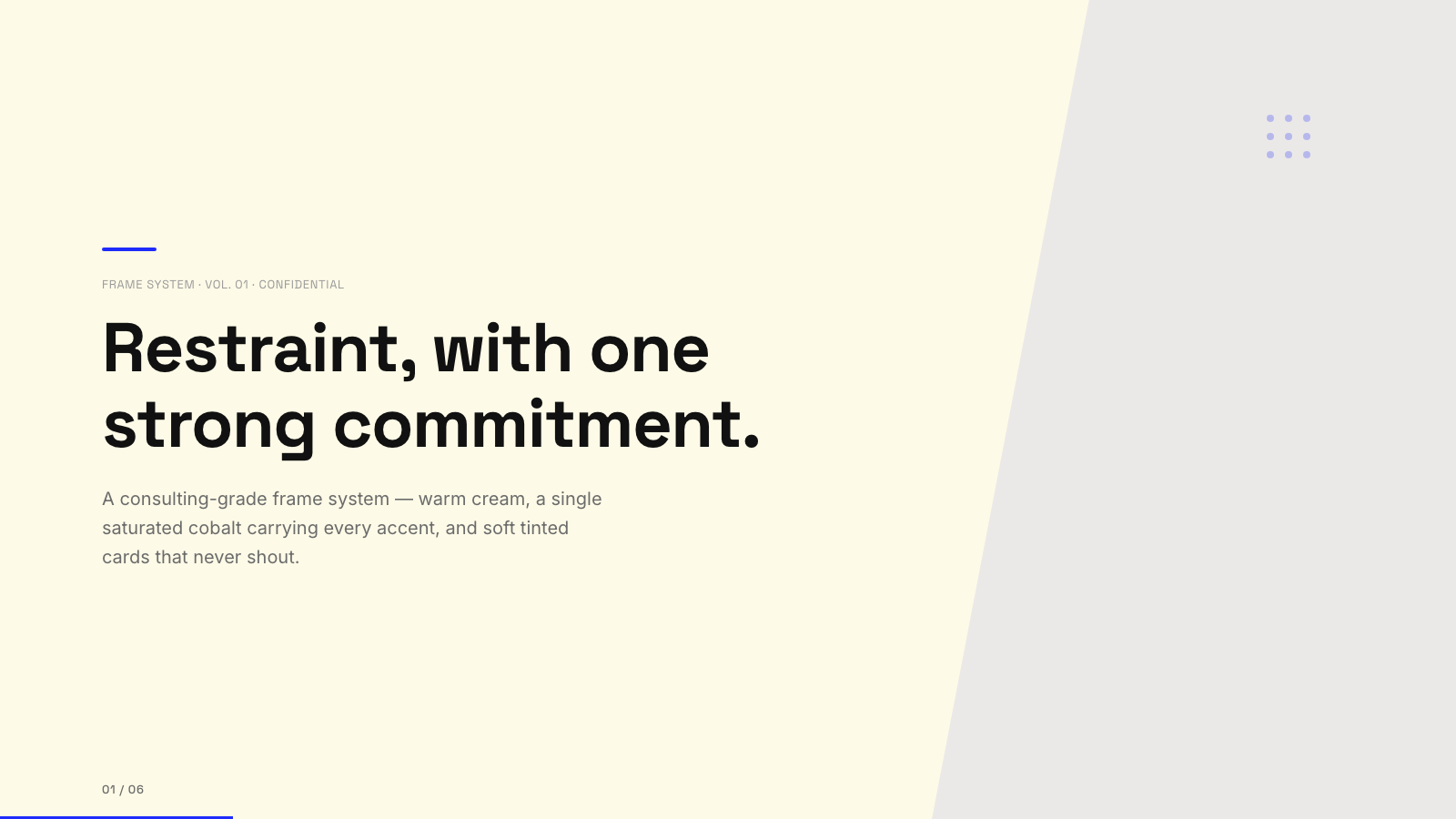
Every brand has a design.md. None of them were written for a camera. frame.md is the missing translation layer: it takes your web-context design spec and inverts it for the frame — the same tokens, the same rules, but rewritten so an AI agent can compose a promo video without guessing at scale or reaching for web chrome.
The output is a DESIGN.md superset your whole toolchain can read. Atoms stay sacred. Composition stays free. Numbers come from the script.

Biennale Yellow |

BlockFrame |
Blue Professional |

Bold Poster |
Browse and remix them all at hyperframes.studio/design.
How It Works
Define a video as HTML. Add data attributes for timing and tracks. Use GSAP, CSS, Lottie, Three.js, Anime.js, WAAPI, or your own frame adapter for seekable animation.
<div id="stage" data-composition-id="launch" data-start="0" data-width="1920" data-height="1080">
  <video
    class="clip"
    data-start="0"
    data-duration="6"
    data-track-index="0"
    src="intro.mp4"
    muted
    playsinline
  ></video>

  <h1 id="title" class="clip" data-start="1" data-duration="4" data-track-index="1">Launch day</h1>

  <audio
    data-start="0"
    data-duration="6"
    data-track-index="2"
    data-volume="0.5"
    src="music.wav"
  ></audio>

  <script src="https://cdn.jsdelivr.net/npm/gsap@3/dist/gsap.min.js"></script>
  <script>
    const tl = gsap.timeline({ paused: true });
    tl.from("#title", { opacity: 0, y: 40, duration: 0.8 }, 1);
    window.__timelines = window.__timelines || {};
    window.__timelines.launch = tl;
  </script>
</div>
Preview instantly in the browser. Render locally or in Docker. The renderer seeks each frame in headless Chrome and encodes the result with FFmpeg, so the same input produces the same video.
Why HyperFrames?
- HTML-native: make videos programmatically with HTML, CSS and JavaScript; compositions are HTML files with data attributes. No React requirement, no proprietary timeline format.
- Agent-friendly: agents already write HTML, and the CLI is non-interactive by default.
- Deterministic: same input, same frames, same output. Built for CI, regression tests, and automated rendering.
- No build step: an
index.htmlcomposition plays as-is and can be previewed directly in the browser. - Adapter-based animation: bring GSAP, CSS animations, Lottie, Three.js, Anime.js, WAAPI, or a custom runtime.
- Open source: Apache 2.0 license, with no per-render fees or commercial-use thresholds.
HyperFrames vs Remotion
HyperFrames is inspired by Remotion. Both tools render video with headless Chrome and FFmpeg. The main difference is the authoring model: Remotion's bet is React components; HyperFrames' bet is plain HTML that humans and agents can both write easily.
| HyperFrames | Remotion | |
|---|---|---|
| Authoring | HTML + CSS + seekable animation | React components |
| Build step | None; index.html plays as-is |
Bundler required |
| Agent handoff | Plain HTML files | JSX / React project |
| Library-clock animations | Seekable, frame-accurate via adapters | Wall-clock animation patterns need care |
| Distributed rendering | Local and AWS Lambda render paths | Remotion Lambda, mature cloud renderer |
| License | Apache 2.0 | Source-available Remotion License |
Read the full comparison in the HyperFrames vs Remotion guide, or the side-by-side comparison page.
Catalog
Install ready-to-use blocks and components:
npx hyperframes add flash-through-white   # shader transition
npx hyperframes add instagram-follow      # social overlay
npx hyperframes add data-chart            # animated chart
Browse the catalog at hyperframes.heygen.com/catalog.
HyperFrames Stack
HyperFrames is the open-source rendering engine, plus a growing set of tools around HTML-native video creation.
| Piece | Status | What it does |
|---|---|---|
| CLI | Available | Scaffold, preview, lint, inspect, and render local video projects |
| Core / Engine / Producer | Available | Parse compositions, drive headless Chrome, encode video, and mix audio |
| Catalog | Available | Reusable blocks and components for transitions, overlays, captions, charts, maps, and effects |
| Agent skills | Available | Teach coding agents the video-production patterns that generic web docs miss |
Browser editor (hyperframes preview) |
Available, evolving | Preview and edit compositions in the browser: canvas, timeline, keyframes |
| AWS Lambda rendering | Available | Deploy a distributed render stack and drive renders from your laptop or CI |
| hyperframes.studio | Available | The HyperFrames Studio app for Mac, Windows and Linux, plans and community |
| frame.md | Available | Invert your design system for the camera — a DESIGN.md superset an agent can compose video from |
Packages
| Package | Description |
|---|---|
hyperframes |
CLI for creating, previewing, linting, and rendering compositions |
@hyperframes/core |
Types, parsers, generators, linter, runtime, and frame adapters |
@hyperframes/engine |
Seekable page-to-video capture engine using Puppeteer and FFmpeg |
@hyperframes/producer |
Full rendering pipeline for capture, encode, and audio mix |
@hyperframes/studio |
Browser-based composition editor UI |
@hyperframes/player |
Embeddable <hyperframes-player> web component |
@hyperframes/shader-transitions |
WebGL shader transitions for compositions |
@hyperframes/aws-lambda |
AWS Lambda SDK and deployment surface for distributed renders |
Documentation
Full documentation: hyperframes.heygen.com/introduction
Community
HyperFrames is used in production at HeyGen, with community examples from teams like tldraw, TanStack, and others in ADOPTERS.md. Open a PR if your team is using HyperFrames.
- Questions and ideas: Discord
- Bugs and feature requests: GitHub Issues
- User research: Book a casual 30-minute conversation with the HyperFrames team — no preparation or sales pitch
- Security reports: SECURITY.md
- Contributions: CONTRIBUTING.md
- Follow along: X · YouTube
Development Note
The repo uses Git LFS for golden regression-test baselines under packages/producer/tests/**/output.mp4 (about 240 MB of .mp4 files). If you're cloning the full repo for development, install Git LFS first:
# macOS
brew install git-lfs

# Ubuntu / Debian
sudo apt install git-lfs

# Windows
winget install GitHub.GitLFS

# Then, once per machine
git lfs install
If you only need source files, you can skip LFS content:
GIT_LFS_SKIP_SMUDGE=1 git clone https://github.com/heygen-com/hyperframes.git